Subtypes
Arctic (Grey Wolf Subtype)

By Stephan Sprinz - [1], CC BY-SA 4.0, https://commons.wikimedia.org/w/index.php?curid=174691564
Canis lupus crassodon
Arctic wolves are a subspecies of grey wolves that spend their entire lives in the arctic region. Due to genetic and ecological similarities, the subspecies also includes the extinct Bernard's wolf (C. l. bernardi) and the Greenland wolf (C. l. orion). It is a medium subspecies that tends to be smaller, have a narrower braincase, white colour and larger carnassials than that of the northwestern subspecies. Their colour is typically shades of white or cream with other populations descriped as having black tipped hair along the back.
Range: The Queen Elizabeth Islands, Ellesmere Island and northwest Greenland
Habitat: Arctic tundra
Size: 32-80 kg (70 to 175 lb); 100-180 cm (36 to 62 in).
Life Span: 6-8 years in the wild; 14-17 years in captivity.
Feeding: Carnivore.
Reproduction: Monogamous. Dominant pairs in packs are the only members to breed. Breeding occurs between January and April. Female grey wolves choose their mates to form life-long pairs. Gestation lasts 60 to 63 days with litters of up to fourteen. Pups remain in the den until 8 to 10 weeks old. Puppies are cared for by the entire pack and are fed regurgitated food until 45 days old. Afterwards, they are weaned and are fed meat by the pack. They begin hunting with the pack at 10 months old. Females reach maturity at two years while males reach it at three. Most wolves leave their birth pack between 1 and 3 years old.
Conservation Status: Least concern. Grey wolves do not adapt well to zoos due to their inability to preform natural behaviours and have large enough spaces. Most animals kept in zoos are unable to be rereleased or are serving for reintroduction efforts.
-------------------------------------------------------------------------------------------------
Full Classification:
| Kingdom: | Animalia |
| Phylum: | Chordata |
| Class: | Mammalia |
| Order: | Carnivora |
| Family: | Canidae |
| Genus: | Canise |
| Species: | C. lupus |
| Subspecies: | C. l. arctos |
Vancouver Island (Grey Wolf Subtype)
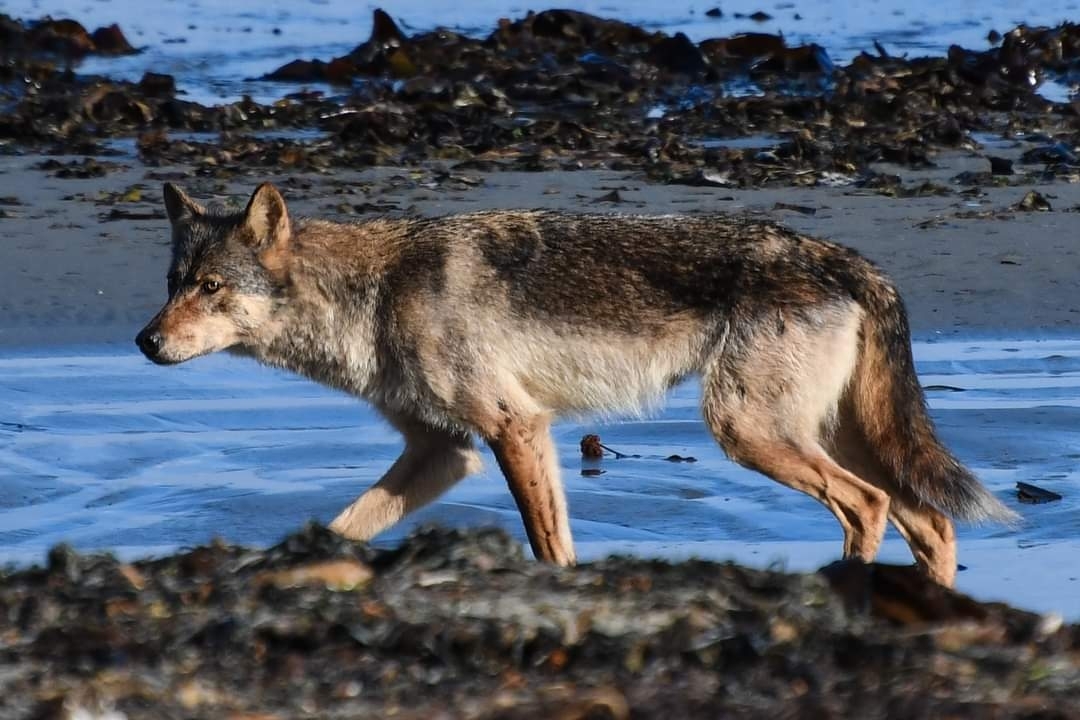
Photo 161788080, (c) Marcie Callewaert John, some rights reserved (CC BY-NC) https://www.inaturalist.org/photos/161788080
Canis lupus crassodon
Vancouver Island wolves can be generalized as sea or coast wolves. This subspecies of grey wolf is genetically and ecologically similar to other coastal wolf subspecies such as British Columbia wolf and the Alexander Archipelago wolf leading to the argument that they should be considered a single subspecies. These wolves are semi-aquatic and capable of swimming up to 7.5 miles between land. They forage for marine life and can also hunt terrestrial mammals. These animals come in colours of brown, grey, beige, white and black. Wolves that primarily live on islands and coastlines tend to be lighter than those that live more inland. Males tend to be larger than females.
Range: Coast wolves range extends along the entirety of the Pacific Northwest through British Columbia and along the Alexander Archipelago.
Habitat: Coastline, islands, and temperate rainforest.
Size: 29-68 kg (65 to 150 lb); 120-178 cm (47.24 to 70 in).
Life Span: 6-8 years in the wild; 14-17 years in captivity.
Feeding: Carnivore.
Reproduction: Monogamous. Dominant pairs in packs are the only members to breed. Breeding occurs between January and April. Female grey wolves choose their mates to form life-long pairs. Gestation lasts 60 to 63 days with litters of up to fourteen. Pups remain in the den until 8 to 10 weeks old. Puppies are cared for by the entire pack and are fed regurgitated food until 45 days old. Afterwards, they are weaned and are fed meat by the pack. They begin hunting with the pack at 10 months old. Females reach maturity at two years while males reach it at three. Most wolves leave their birth pack between 1 and 3 years old.
Conservation Status: Least concern. Grey wolves do not adapt well to zoos due to their inability to preform natural behaviours and have large enough spaces. Most animals kept in zoos are unable to be rereleased or are serving for reintroduction efforts.
-------------------------------------------------------------------------------------------------
Full Classification:
| Kingdom: | Animalia |
| Phylum: | Chordata |
| Class: | Mammalia |
| Order: | Carnivora |
| Family: | Canidae |
| Genus: | Canise |
| Species: | C. lupus |
| Subspecies: | C. l. crassodon |
Sicilian (Grey Wolf Subtype)
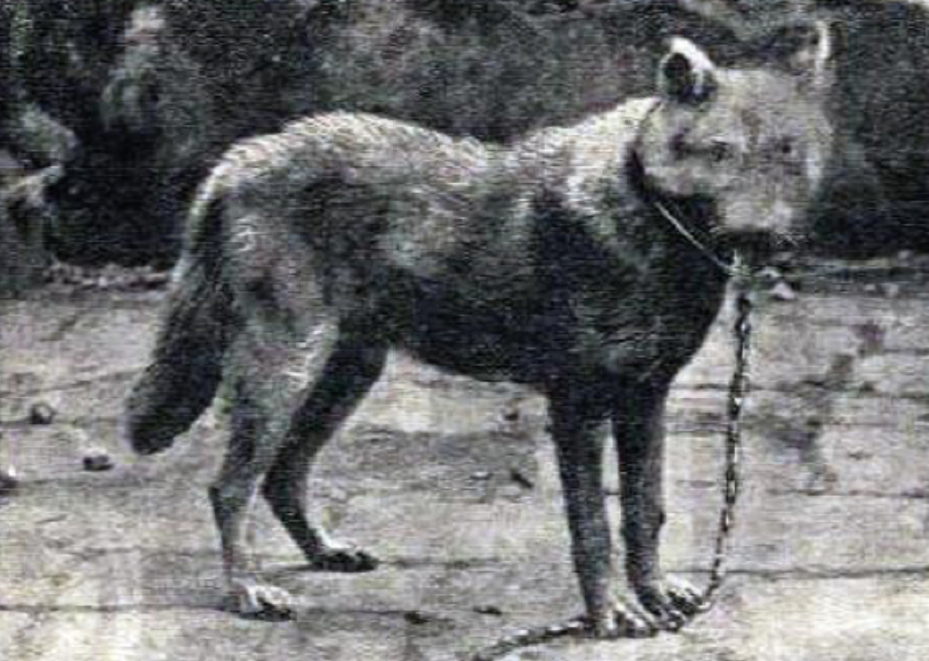
By Mario Migneco - Considerazioni ed appunti sul cane cirneco, Public Domain, https://commons.wikimedia.org/w/index.php?curid=74896198
Canis lupus cristaldii
Sicilian wolves is an extinct subspecies of grey wolves that were endemic to Sicily. They were a slender, short-legged species with light, tawny fur.
Range: The island of Sicily.
Habitat: Previously forests.
Size: 105.4 cm (41.5 in)
Life Span: Unknown.
Feeding: Carnivore.
Reproduction: Monogamous. Dominant pairs in packs are the only members to breed. Breeding occurs between January and April. Female grey wolves choose their mates to form life-long pairs. Gestation lasts 60 to 63 days with litters of up to fourteen. Pups remain in the den until 8 to 10 weeks old. Puppies are cared for by the entire pack and are fed regurgitated food until 45 days old. Afterwards, they are weaned and are fed meat by the pack. They begin hunting with the pack at 10 months old. Females reach maturity at two years while males reach it at three. Most wolves leave their birth pack between 1 and 3 years old.
Conservation Status: Extinct.
-------------------------------------------------------------------------------------------------
Full Classification:
| Kingdom: | Animalia |
| Phylum: | Chordata |
| Class: | Mammalia |
| Order: | Carnivora |
| Family: | Canidae |
| Genus: | Canise |
| Species: | C. lupus |
| Subspecies: | C. l. cristaldii |
To read more visit Animal Diversity Web.
Peacock (African Cichlid Subtype)
Oscar (African Cichlid Subtype)
Fairy (African Cichlid Subtype)
Lemon (African Cichlid Subtype)
Jewel (African Cichlid Subtype)
Dire Wolf x Coyote (Canine Hybrid Subtype)
Grey Wolf x Maned Wolf (Canine Hybrid Subtype)
Snow Leopard x Hybrid (Feline Hybrid Subtype)
Snow Leopard x Siberian Tiger (Feline Hybrid Subtype)
Snow Leopard x Margay (Feline Hybrid Subtype)
Dire Wolf x Grey Wolf (Canine Hybrid Subtype)
Eastern (Marbled Polecat Subtype)
Western (Marbled Polecat Subtype)
Standard (American Black Bear Subtype)

By Jim Martin - Own work, Public Domain, https://commons.wikimedia.org/w/index.php?curid=7816500
Ursus americanus
American black bears are a medium-sized bear endemic to North America. They have broad heads with narrow muzzles and are distinguishable from brown bears by their lack of shoulder hump. They have round, short claws, a small tail, and small, rounded ears. They are dexterous, intelligent, and highly intelligent. Black bears can range in colour from white, blond, cinnamon, brown, silver-grey and black. Males tend to be physically larger, while females have a sharper snout.
Range: Their native range is the near entirety of Canada down to southern California and New England with pockets occurring in much of the western United States and northern Mexico.
Habitat: Black bears have a preference towards habitats with thick vegetation, inaccessible terrain, and abundant sources of food. Can be found in temperate forests and scrub lands.
Size: 39.0-409 kg (85.90 to 900.88 lb); 120-200 cm (47.24 to 78.74 in)
Life Span: 10-32 years in the wild; 25-44 years in captivity
Feeding: Omnivore
Reproduction: Polygynous. Breeding season occurs from June to mid-July with the egg not implanted until autumn and gestation technically lasting only 10 weeks. Births occur in January and February, typically while the female is hibernating, to one to five cubs. Cubs are born blind and naked, remaining in the den with their mother and nurse throughout winter. Cubs are weaned around 6 to 8 months but remain with their mother until around 17 months when their mother forces them out of her territory. Females reach sexual maturity from 2 to 9 years old and males at 3 to 4 but continue to grow until 10 to 12 years old.
Conservation Status: Least concern. American black bears can adapt well to captivity as long as their habitat and enrichment requirements are met.
-------------------------------------------------------------------------------------------------
Full Classification:
| Kingdom: | Animalia |
| Phylum: | Chordata |
| Class: | Mammalia |
| Order: | Carnivora |
| Family: | Ursidae |
| Genus: | Ursus |
| Species: | U. americanus |
Desert (Bighorn Sheep Subtype)

By Andrew Barna, CC BY-SA 3.0, https://commons.wikimedia.org/w/index.php?curid=15111914
Ovis canadensis nelsoni
The desert bighorn sheep is a subspecies of bighorn sheep that is native to the deserts of the United States and northwestern Mexico. This species is well adapted to lack of water, able to go for extended periods without drinking water. They are leaner sheep with longer legs and larger ears than other subspecies. Their body temperatures can safely flucuate several degrees. Moisutre and water is absorbed by the pants they eat and can lose up to 30% of their body weight without facing negative affects. These animals form herds of 8-10 individuals, ocassionally numbering up to 100 individuals with rams and ewes typically living in separate bands during the year. They are light tan to dark brown, typically fading in the winter.
Range: Mojave, Sonoran, Great Basin, Chihuahua Deserts and the Colorado Plateau.
Habitat: Desert
Size: 52-127 kg (115 to 279.74 lb); 150-180 cm (59.06 to 70.87 in)
Life Span: 10-20 years in the wild; up to 20 years in captivity
Feeding: Herbivore
Reproduction: Polygynous. Sexual maturity for females are reached at 2-3 years and males reach sexual maturity at 7 years. Horn size and mass of horns are a symbol of rank with males engaging in battles over mating access for each females. Rutting season occurs in autumn and early winter with births taking place in the spring. Gestation is 150-180 days with one, ocassionally, two lambs born. Lambs are weaned by 4 to 6 months.
Conservation Status: Apparently secure. Adapt readily to captivity.
-------------------------------------------------------------------------------------------------
Full Classification:
| Kingdom: | Animalia |
| Phylum: | Chordata |
| Class: | Mammalia |
| Order: | Artiodactyla |
| Family: | Bovidae |
| Genus: | Ovis |
| Species: | O. canadensis |
| Subspecies: | O. c. nelsoni |
Rocky Mountain (Bighorn Sheep Subtype)
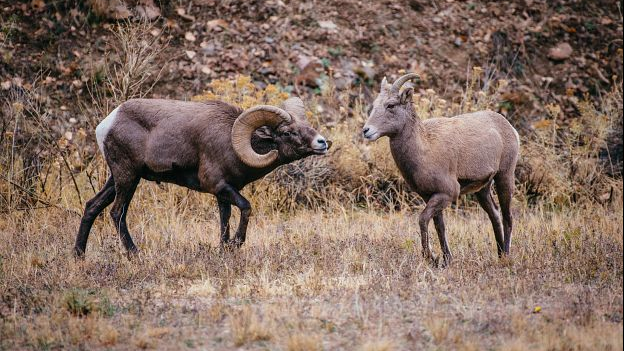
By Colorado Parks and Wildlife, https://cpw.state.co.us/species/rocky-mountain-bighorn-sheep
Ovis canadensis canadensis
The Rocky Mountain bighorn sheep are the nominal subspecies of bighorn sheep. They are typically grey-brown to dark brown with white patches on their rump, uzzles, underbelly and legs. Their coats become substantially darker in the summer. They are the largest sheep with thick, double layered winter coats. They are typically stockier with larger, more tightly curled horns.
Range: Rocky mountains
Habitat: Alpine meadows
Size: 52-127 kg (115 to 279.74 lb); 150-180 cm (59.06 to 70.87 in)
Life Span: 10-20 years in the wild; up to 20 years in captivity
Feeding: Herbivore
Reproduction: Polygynous. Sexual maturity for females are reached at 2-3 years and males reach sexual maturity at 7 years. Horn size and mass of horns are a symbol of rank with males engaging in battles over mating access for each females. Rutting season occurs in autumn and early winter with births taking place in the spring. Gestation is 150-180 days with one, ocassionally, two lambs born. Lambs are weaned by 4 to 6 months.
Conservation Status: Least concern. Adapt readily to captivity.
-------------------------------------------------------------------------------------------------
Full Classification:
| Kingdom: | Animalia |
| Phylum: | Chordata |
| Class: | Mammalia |
| Order: | Artiodactyla |
| Family: | Bovidae |
| Genus: | Ovis |
| Species: | O. canadensis |
| Subspecies: | O. c. canadensis |
Sierra Nevada (Bighorn Sheep Subtype)

By California Department of Fish and Wildlife from Sacramento, CA, USA - bighorn sheep, CC BY 2.0, https://commons.wikimedia.org/w/index.php?curid=69196072
Ovis canadensis canadensis
The Sierra Nevada bighorn is the most elusive of bighorn species, only occuring in the Sierra Nevada mountain range. They are inbetween the size of the Rocky Mountain and Desert bighorns, typically ranging from dark brown to near white with heavy seasonal variation. Their horns are smaller and wider with a less pronounced curl.
Range: Mojave, Sonoran, Great Basin, Chihuahua Deserts and the Colorado Plateau.
Habitat: Desert
Size: 52-127 kg (115 to 279.74 lb); 150-180 cm (59.06 to 70.87 in)
Life Span: 10-20 years in the wild; up to 20 years in captivity
Feeding: Herbivore
Reproduction: Polygynous. Sexual maturity for females are reached at 2-3 years and males reach sexual maturity at 7 years. Horn size and mass of horns are a symbol of rank with males engaging in battles over mating access for each females. Rutting season occurs in autumn and early winter with births taking place in the spring. Gestation is 150-180 days with one, ocassionally, two lambs born. Lambs are weaned by 4 to 6 months.
Conservation Status: Threatened. Adapt readily to captivity.
-------------------------------------------------------------------------------------------------
Full Classification:
| Kingdom: | Animalia |
| Phylum: | Chordata |
| Class: | Mammalia |
| Order: | Artiodactyla |
| Family: | Bovidae |
| Genus: | Ovis |
| Species: | O. canadensis |
| Subspecies: | O. c. sierrae |